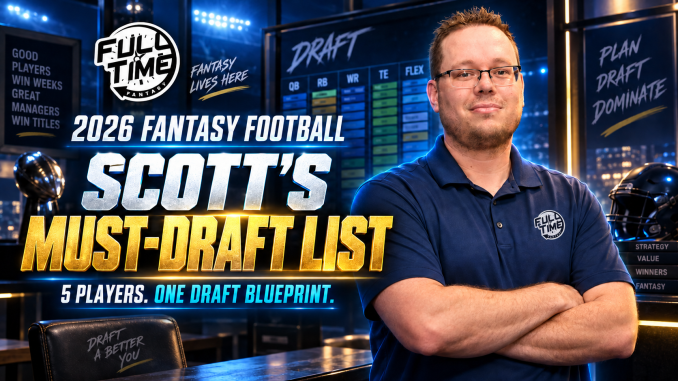
Scott’s 2026 Must-Draft List
Secure these five priority targets in Rounds 3, 4, 6, 8 and 9—then use best player available to build the rest of a championship roster around them.
Plan the Targets. Let the Draft Supply the Rest.
“Best player available” is good advice until it becomes an excuse to leave every draft with the same players everyone else values. Championship rosters need value, but they also need conviction.
My approach is to identify a small number of players whose ceiling, role or price I believe the market is still underestimating. I reserve their rounds before the draft begins. Everywhere else, I stay flexible and take the best player on my board.
The objective is not to win ADP. It is to leave the room with the players you believe can win the league. If that requires paying a small premium, pay it. The regret of taking one of these players six picks early is far smaller than watching him disappear six picks before your next turn.
Scott’s Must-Draft Card
| ROUND | PLAYER | POS / TEAM | MARKET PRICE | THE BET |
|---|---|---|---|---|
| 3 | Jeremiyah Love | RB — ARI | NFC ADP 36 | No. 3 pick with league-winning RB1 upside |
| 4 | Colston Loveland | TE — CHI | FP ADP 46 | 155 vacated targets and elite TE usage |
| 6 | Carnell Tate | WR — TEN | FP ADP 73 | Pay one round for a potential rookie alpha |
| 8 | Kenneth Gainwell | RB — TB | FP ADP 89 | Scott’s RB25 versus market RB31–35 |
| 9 | Matthew Golden | WR — GB | Live PPR ADP 104 | 131 vacated targets create Year 2 runway |
Target rounds are a draft plan, not a promise that every room will cooperate. If one of these players is routinely going earlier in your format, adjust before the draft—not after he is gone.
Jeremiyah Love, RB, Arizona Cardinals
Draft the season-long ceiling—not one September box score.
Love is the first player I am building around. Arizona did not spend the No. 3 overall pick on a running back to make him a decorative part of the offense. That investment creates a clear path to becoming the lead option even with James Conner and Tyler Allgeier on the depth chart.
The résumé supports the investment. During his final two college seasons, Love ranked inside the top 15 among running backs in yards after contact per attempt, breakaway rate and elusive rating. He was not only an explosive runner; his 10.9% target share and top-20 yards-per-route-run mark among FBS backs showed the receiving skill required for a three-down fantasy ceiling.
NFC high-stakes ADP still places him at No. 36 overall, but the high-ankle sprain has created room-specific discounts into the third. That is the opportunity. The injury can affect September without defining October through December.
I am not drafting Love because I need 18 points in Week 1. I am drafting him because the healthiest and most important version of Love could arrive when fantasy leagues are being decided. A 65–70% rushing share, passing-game work and premium breakaway ability would give him a legitimate top-10 path.
Scott’s call: Take Love in Round 3, then use the next several BPA selections to protect the roster. Do not pass on a potential league-winning back simply because the first week or two may be uncomfortable.
Colston Loveland, TE, Chicago Bears
Buy the Year 2 leap before the price becomes obvious.
Ben Johnson now has a second-year tight end he drafted 10th overall to fill the movable mismatch role he previously created for Sam LaPorta.
Loveland gave us the foundation as a rookie: 58 receptions, 713 yards and six touchdowns. The full-season line is good. The finish is the signal. From Week 9 through Chicago’s two playoff games, Loveland caught 59 of 89 targets for 790 yards and six scores. Over his final four games, including the postseason, he averaged 12 targets and 20 fantasy points.
Now add 155 vacated targets to an offense entering Year 2 under Ben Johnson. Johnson’s first Bears draft produced Loveland with the No. 10 overall selection, and he told the young tight end that he saw similarities to Sam LaPorta and envisioned using him in the same movable mismatch role. That is not a loose player comparison; it tells us how the coach wants to deploy him.
Cole Kmet’s role has already shifted toward blocking—he drew only 48 targets last season—while Loveland led Chicago in catches and receiving yards. The passing-game hierarchy is not guaranteed, but the evidence says Loveland is moving toward the center of it.
His NFC Footballguys PPR ADP is No. 44, mid way through Round 4 in a 12-team league. I do not wait for the turn. A fourth-round tight end must create separation from the position, and Loveland has an overall TE1 path if even a meaningful portion of those available targets flows through him.
Update 9/6: Someone just scored Love at 4.12 in a high-stakes draft! There is a case for Loveland FIRST then Love, I’m fine with you flipping these picks order but realize there’s a risk of you missine one or the other. Again, my preference is to overpay for your targets to lock them in.
Scott’s call: Reserve Round 4 for Loveland. You are buying a weekly positional edge and removing the need to chase tight end later.
Carnell Tate, WR, Tennessee Titans
The talent and opportunity are arriving at the same time.
Tennessee selected Tate fourth overall because he brings the traits of a future featured receiver: polished routes, downfield ability, elite body control and a large catch radius. At Ohio State, he produced 121 receptions for 1,872 yards and 14 touchdowns while sharing the field with future NFL talent. He already understands how to earn targets without being force-fed.
The choice itself tells us how much Tate means to Tennessee’s plan. The Titans had the opportunity to take Ohio State linebacker Sonny Styles, one of the premier defensive prospects in the class—and passed. With Styles and other highly rated defenders still on the board, Tennessee chose a wide receiver to grow alongside Cam Ward. Teams reveal their priorities through premium draft capital, and the Titans made supporting their franchise quarterback the priority.
The fit with Cam Ward matters. Tate’s ability to adjust outside his frame gives Ward a forgiving target when a play breaks structure, while his route polish gives the second-year quarterback a receiver who can win on schedule. Tennessee did not have a true perimeter answer; it used a top-five pick to create one.
The NFC ADP market places Tate at No. 64, essentially mid to late sixth is where he’s going now. Taking him in the sixth is not a wild reach. It is a controlled premium of roughly one round to remove the risk that the manager behind you makes the same bet.
Tate does not need an immediate 150-target season to pay off. If he establishes himself as Ward’s primary outside receiver and earns seven to eight targets per game, the touchdown and big-play ceiling can push him comfortably beyond WR3 pricing.
Scott’s call: Make Tate your Round 6 upside receiver. The ceiling is worth paying for before the breakout appears in the box score.
Kenneth Gainwell, RB, Tampa Bay Buccaneers
A modest projection can still hide a championship-level payoff.
Gainwell is FullTime Fantasy’s 2026 Sleeper of the Year—the player we believe has the clearest combination of affordable draft cost, standalone weekly value and a ceiling the market has not fully priced. The complete case is available in our 2026 Fantasy Football Sleeper of the Year feature.
Gainwell is exactly the kind of player high-stakes drafters identify before the broader market catches up. Tampa Bay signed him after Rachaad White’s departure because he supplies the traits coaches trust: versatility, pass protection and third-down receiving value. Pass protection is especially important here—it is what keeps a running back on the field when the game script turns pass-heavy.
Our current projection gives Gainwell 107 carries for 468 yards and four rushing touchdowns, plus 46 receptions for 333 yards and three receiving touchdowns. That is 153 touches, 801 yards and seven scores, enough standalone production to matter in PPR leagues.
Scott ranks him as RB25, ahead of both his high-stakes RB31 price and the RB35 consensus. FantasyPros’ overall PPR ADP of 89 places him in the middle of Round 8. The bullish scenario goes beyond the median projection: Gainwell earns a larger share of passing situations, becomes a trusted red-zone option and turns a committee label into consistent weekly usability.
Bucky Irving does not have to miss time for this to work. Forty-six receptions carry real value on their own, and Tampa Bay can support two backs if Gainwell owns the passing-down and change-of-pace work. An injury would increase the ceiling, but it is not the thesis.
That is why we take him in the eighth. Waiting another round to “beat ADP” risks losing a back whose receiving role can score now and whose ceiling can grow dramatically as the season develops.
Scott’s call: Pay the Round 8 price. Gainwell does not need an injury to return value, and any expansion beyond the projection creates a path to a much higher finish.
Matthew Golden, WR, Green Bay Packers
The rookie season was the setup. Year 2 can be the payoff.
Golden’s rookie numbers—29 catches for 361 yards—will push some fantasy managers away. Look closer. He ranked fourth among qualifying rookie receivers with 8.2 yards per target and caught 11 passes for 232 yards on third and fourth down. That 21.1-yard average in the highest-leverage situations ranked third in the NFL among players with at least 10 such receptions.
Then came the playoff flash: four catches for 84 yards and a touchdown against Chicago. That performance does not guarantee a breakout, but it showed the first-round receiver could produce when Green Bay gave him meaningful opportunities.
The 2026 opportunity is materially different. Romeo Doubs left after drawing 85 targets, and Green Bay traded Dontayvion Wicks after another 46. That is 131 vacated targets. Golden already played 487 snaps as a rookie—second among Packers wide receivers—and now has a cleaner runway into a starting outside role.
The market disagreement is telling. Broad composite data remains much lower, but active PPR drafts have Golden near pick 104, the ninth round of a 12-team league. That is where I act. Christian Watson and Jayden Reed will command work, but Golden does not need an alpha-level target share to beat WR4 pricing. A jump from 55 targets into the 85–95 range would change his weekly ceiling completely.
Scott’s call: Use Round 9 to buy Golden before the Year 2 role becomes obvious. The cost is depth-receiver pricing; the payoff can be a weekly starter.
The Complete Draft Construction
Five conviction picks create the spine. Flexibility everywhere else keeps the roster strong.
Build the Elite Base
Take the two best players available. Do not force a position because of the targets coming later. Bank elite volume and scoring.
Love + Loveland
Secure the upside running back and the tight-end advantage. These are planned picks, not decisions to reconsider while the clock runs.
Take the Fall
Use BPA. This is where a player who slipped can balance the build—often a high-volume receiver or another starting back.
Take Tate
Add the rookie receiver before his ceiling is priced into the market.
Stay Flexible Again
Take the strongest value. Quarterback is acceptable if an impact option falls; otherwise add another RB or WR.
Close with Gainwell + Golden
Complete the five-player core with two affordable bets whose roles can outperform their current prices.
Finish for Upside
Fill quarterback if needed, add contingent-value backs and chase receivers with paths to growing target shares. Avoid low-ceiling bench fillers.
What If the Room Jumps You?
A blueprint is not permission to panic. If a manager takes one of these players well ahead of the planned round, do not chase the loss with a reckless reach somewhere else. Take the best player available and preserve the value of the roster.
The preparation happens before the draft. Know the player pool, know your platform and know how aggressive your room tends to be. If you repeatedly see one of these targets go before your selection, move the reservation up. The small premium is the price of certainty.
The larger principle remains intact: conviction at the planned pressure points, BPA everywhere else. That combination gives you a roster you believe in without sacrificing the value the draft naturally presents.
Do Not Leave Your Favorite Players to Chance
Jeremiyah Love in the third. Colston Loveland in the fourth. Carnell Tate in the sixth. Kenneth Gainwell in the eighth. Matthew Golden in the ninth. Use best player available to build around them—and leave the draft with five players capable of making the entire plan look obvious by December.
Read Next on FullTime Fantasy
Scott’s five-player blueprint is one part of the complete plan. Continue with our newest high-stakes features, premium conviction picks and updated rankings.
PREMIUM · PRESEASON PRO
Oliver Dawoud’s Five Fantasy Football Picks
The FFWC record-holder reveals his sleeper, breakout, bust, comeback and Stash & Cash.
FREE · PRESEASON PRO
Ian Ritchie’s 2026 Fantasy Football Picks
A former world No. 1 puts his breakout, bust, sleeper and late-round targets on the board.
Editorial update: September 6, 2026. Draft prices can vary by platform, scoring format and room. Monitor Jeremiyah Love’s ankle status before finalizing Week 1 lineups.
Player and team background: Arizona Cardinals · Chicago Bears · Tennessee Titans · Tampa Bay Buccaneers · Green Bay Packers