
Sunday starts in Madrid. Get the Cincinnati and Atlanta decisions settled before 9:30 a.m. ET, then work through the rest of the slate with a plan for the late-game injury questions.
Our biggest Week 9 convictions remain Malik Willis at QB4, Zach Charbonnet as an RB2 and Greg Dulcich inside the top 10 at tight end. This guide goes beyond the bold calls: every remaining game has starts, sits and the flex options that become useful as your league gets deeper.
Friday changes to know: Garrett Wilson is out; Breece Hall is off the injury report. Shedeur Sanders will start for Cleveland, Drew Lock is expected to replace Sam Darnold, and Joe Milton will start for Philadelphia. Terrance Ferguson’s expected return requires another look at Thursday’s Tyler Higbee recommendation.
GAME 01 · Sunday, November 8 · 9:30 a.m. ET
Cincinnati vs. Atlanta — Madrid
Set an alarm. Madrid gives us Joe Burrow and Bijan Robinson near the very top of our board, and this is a game to get your proven starters into the lineup before the early lock.
Start: Joe Burrow (QB2), Chase Brown (RB8), Ja'Marr Chase (WR6), Tee Higgins (WR11), Bijan Robinson (RB1), Drake London (WR8) and Kyle Pitts Sr. (TE7). Michael Penix Jr. is QB12: a reasonable 12-team streamer and a strong superflex option, with better choices available in many 10-team leagues.
Flex and deeper leagues: In 14–16-team PPR leagues, Samaje Perine (RB38) is a low-ceiling second-flex option when touches are scarce. Mike Gesicki (TE15) is a 14–16-team TE streamer or a two-TE starter, rather than an automatic 10–12-team TE1. We prefer Pitts in this game.
Sit / prefer another option: Dohnte Meyers (WR60) and Jahan Dotson (WR75) in ordinary 10–12-team lineups. Meyers is an emergency receiver in unusually deep formats; a favorable prop line does not make him a dependable season-long starter.
What our tools say: Brown played 69% of the snaps and handled 20 touches in Week 8; Bijan played 81%. Pitts managed only two catches last week, but five targets and our TE7 projection keep him in the lineup. The WR Matchups report marks London’s WR1 assignment as difficult (#7), yet he remains our WR8. The matchup is a caution, not a reason to bench his projected production.
Before lock: Atlanta has ruled out Brian Robinson Jr. That removes one backfield alternative, but Bijan was already our RB1. Put your Madrid RBs and WRs in their position-specific slots, leaving later players in FLEX to preserve Sunday options.
GAME 02 · Sunday, November 8 · 1 p.m. ET
Denver at Carolina
Jonah Coleman’s workload is the useful Denver story. The receivers are much tougher lineup decisions.
Start: Jonah Coleman (RB12) as an RB2 and Chuba Hubbard (RB6) as an RB1. Tetairoa McMillan (WR24) is a lower-end WR2 in 12-team leagues; Denver’s difficult receiver matchup trims expectations without turning him into an automatic bench.
Flex and deeper leagues: Jalen Coker (WR28) is a WR3/FLEX for 12-team leagues starting three receivers, with less appeal in a shallow two-WR format. Jaylen Waddle (WR39) and Courtland Sutton (WR43) are primarily 14–16-team flex choices. J.K. Dobbins (RB34) is a deeper-league RB flex behind Coleman, not a co-equal starting recommendation.
Sit / prefer another option: Bo Nix (QB26) in one-QB leagues, plus Evan Engram (TE33) and Darren Waller (TE35) in ordinary one-TE formats. Bryce Young (QB17) is a superflex/QB2 option; we would not reach for him in a 10–12-team one-QB league.
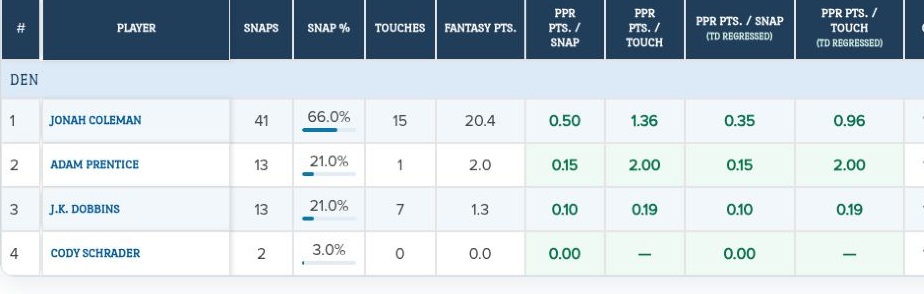
What our tools say: Coleman’s RB2 call has both workload and production behind it. He played 41 snaps (66%) with 15 touches, versus 13 snaps (21%) and seven touches for Dobbins. Removing Coleman’s touchdown drops his PPR rates from 0.50 to 0.35 points per snap and from 1.36 to 0.96 per touch. Both remain well ahead of Dobbins’ 0.10 and 0.19 without touchdown points. That supports Coleman ahead of Dobbins without depending on another score. Hubbard’s 92% share and 29 touches are even sturdier volume. Coker played 86%; his #23 WR2 matchup is softer than McMillan’s #12 WR1 assignment. Use our live rankings and Snap Counts together when comparing either Denver back with your flex alternatives.
Before lock: Tommy Tremble (TE24) is a two-TE or very deep streamer, not our preferred TE1. His low receiving-yardage prop is a separate decision from starting him over a top-12 tight end.
GAME 03 · Sunday, November 8 · 1 p.m. ET
Dallas at Indianapolis
We want the primary skill players here, but the attractive matchup does not automatically put Daniel Jones into a one-QB lineup.
Start: Dak Prescott (QB7), Javonte Williams (RB10), CeeDee Lamb (WR5), Jonathan Taylor (RB5) and Keenan Allen (WR23). George Pickens (WR15) is a WR2 if active and able to handle his normal role; he is officially questionable with the hamstring issue.
Flex and deeper leagues: Josh Downs (WR30) is a 12-team WR3/FLEX. Ryan Flournoy (WR45) belongs in the 14–16-team discussion, with additional interest if Pickens sits. If that happens, refresh the rankings before assigning Flournoy a larger role. In a 10-team, two-WR league, neither is a must-start over a stronger bench option.
Sit / prefer another option: Daniel Jones (QB25) in one-QB leagues. Tyler Warren (TE17) is below our ordinary 10–12-team TE1 line; he is still usable in 14–16-team or two-TE formats when the alternatives are thin.
What our tools say: Taylor is our RB5 despite the poor previous box score. Warren drew 10 targets on 72% of the snaps last week, so the usage is worth keeping; it simply does not erase his TE17 projection. The WR Matchups report also separates Indianapolis’s WR2 defense (#4, difficult) from its aggregate receiver matchup. Pickens carries more risk than Lamb, especially with the injury.
Before lock: Do not confuse a useful Dallas DFS value with a guaranteed season-long starter. For a close Downs/Flournoy decision, compare the updated projections after the Pickens news.
GAME 04 · Sunday, November 8 · 1 p.m. ET
New York Jets at Kansas City
Friday’s news changes the Jets portion of Thursday’s article: Breece Hall is off the injury report, and Garrett Wilson is out.
Start: Kenneth Walker III (RB4), Rashee Rice (WR16) and Travis Kelce (TE11). Patrick Mahomes (QB11) is a 12-team QB1; he is a borderline choice in a 10-team league with a stronger alternative.
Flex and deeper leagues: Breece Hall (RB26) is a 10–12-team flex rather than a top-24 RB on this snapshot. His return is welcome, but we are not projecting a premium matchup. Braelon Allen (RB32) is a last-resort 14–16-team flex if you need his remaining work; Hall’s return removes the standalone role that supported Allen’s recent production.
Sit / prefer another option: Garrett Wilson is an availability sit after being ruled out. Sit Geno Smith (QB22) in one-QB formats, and keep Xavier Worthy (WR64), Mason Taylor (TE26) and Kenyon Sadiq (TE34) outside ordinary 10–12-team starting lineups. Kelce is the clear TE preference here.
What our tools say: Allen’s 83% snap share and 23 touches came with Hall unavailable; those are replacement-role numbers. The more interesting receiving evidence belongs to Mitchell: nine targets, seven catches and 27.2 PPR points on 39 snaps. Even after removing his touchdown, he produced 0.54 points per snap and 3.03 per touch. That is a reason to consider him in a 14–16-team league with Wilson out, especially when chasing upside. It is still one game. Kansas City’s #2 grade against the listed WR2 role is difficult, and Wilson’s absence could change who fills that role.
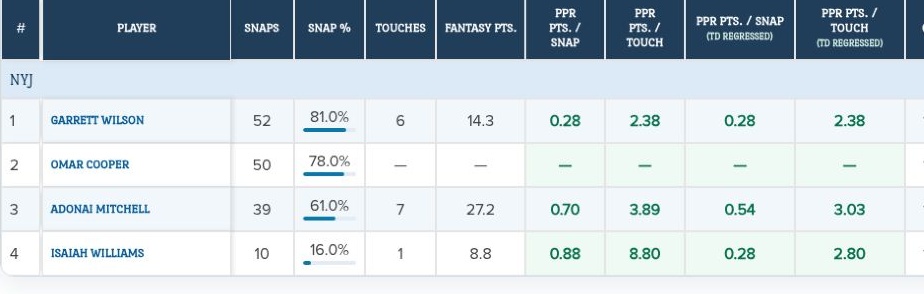
Before lock: Our captured board still includes Wilson at WR19; the ruled-out news overrides it. Mitchell (WR65 on that earlier snapshot) is my preferred speculative deep-league receiving option here based on the Week 8 evidence, pending a post-news update. Cooper played 50 snaps (78%), but his receiving and efficiency fields are missing in this report. Those dashes are not zeroes, and they do not establish an efficiency edge for either player.
GAME 05 · Sunday, November 8 · 1 p.m. ET
Detroit at Miami
Malik Willis and Greg Dulcich remain two of our clearest calls from the Thursday guide. There are enough usable players here to make league format matter.
Start: Malik Willis (QB4), Jared Goff (QB8), Jahmyr Gibbs (RB2), Amon-Ra St. Brown (WR3), Sam LaPorta (TE5), Malik Washington (WR21) and Greg Dulcich (TE9), assuming the active players have no new restrictions. Willis is a start even in 10-team leagues on our QB4 ranking.
Flex and deeper leagues: Caleb Douglas (WR27) is a 12-team WR3/FLEX. Jameson Williams (WR33) remains a 12-team WR3 or flex, not a blanket sit. Ollie Gordon II (RB25) is a 12-team flex and a more comfortable option in 14–16-team leagues. Chris Bell (WR36) is a deeper flex, best suited to 14–16 teams or leagues with extra WR/FLEX spots.
Sit / prefer another option: Bell is usually a bench in a shallow 10-team format despite his prop value. Do not turn the entire Miami receiving depth chart into automatic starts because Detroit is vulnerable.
What our tools say: Dulcich’s case starts with a usable role: 45 snaps (69%), six targets, a 20% target share and four catches in Week 8. His 8.3 PPR points came without a touchdown, so 0.18 points per snap and 2.08 per touch stay unchanged in the TD-regressed columns. That is modest overall production with a real receiving role, rather than a touchdown hiding an empty workload. Combine it with our TE9 ranking and Detroit’s favorable TE profile in Points Allowed, and he is a defensible 12-team start. The WR Matchups report also gives Washington the #31 WR1 assignment, while St. Brown draws #2; St. Brown remains our WR3 because the full projection still favors his talent and volume. Open the rankings and matchup report together for your final comparison.

Before lock: St. Brown carries a limited-practice/questionable flag on the ranking snapshot. Confirm his final status. For DFS, use Ask Max on the correct slate; this article’s PPR season-long ranks are not DraftKings salary values.
GAME 06 · Sunday, November 8 · 1 p.m. ET
Cleveland at New Orleans
Cleveland is starting Shedeur Sanders. That is confirmed news, not the conditional Deshaun Watson projection that appeared earlier in the week.
Start: Quinshon Judkins (RB17), Chris Olave (WR10), Juwan Johnson (TE8) and, if active without a new limitation, Denzel Boston (WR17), KC Concepcion Jr. (WR22) and Harold Fannin Jr. (TE6). Alvin Kamara (RB23) is an RB2 if cleared for his expected work.
Flex and deeper leagues: Dylan Sampson (RB36) is a 14–16-team PPR flex, especially in a second flex slot. Devaughn Vele (WR46) is a deeper receiver option rather than a 10–12-team start. If Boston is limited or inactive, revisit the receiving projections rather than assuming every missing target goes to Concepcion.
Sit / prefer another option: Deshaun Watson is not the starting quarterback. Shedeur Sanders (QB19) and Tyler Shough (QB15) belong primarily in superflex/QB2 lineups; Shough can be considered as a 14–16-team one-QB streamer. Sit Jerry Jeudy (WR81) in normal formats.
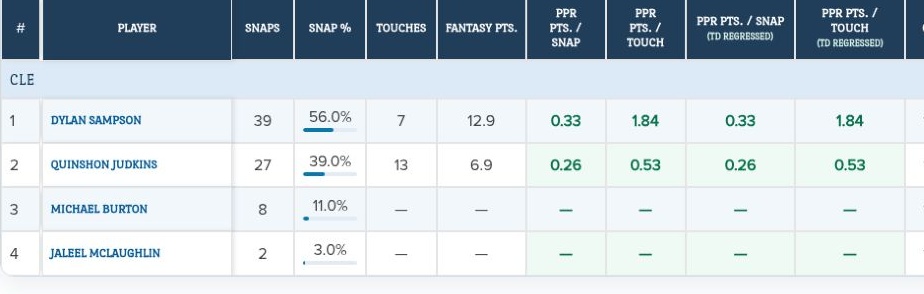
What our tools say: The snap lead alone would overstate Sampson’s job: he played 39 snaps (56%) to Judkins’ 27 (39%), but Judkins led 13–7 in touches. The PPR distinction is receiving work. Sampson drew eight targets and caught six passes, with 12.9 points and 0.33 per snap / 1.84 per touch. Those rates are unchanged after removing touchdown points. Judkins finished at 0.26 / 0.53. Sampson’s one-game receiving production supports a 14–16-team PPR flex; it does not make seven touches a workhorse workload or erase our RB17 versus RB36 rankings. Fannin’s 12 targets, 10 catches and 86% snap share produced 23.4 PPR points without a touchdown, another strong reason to start him if cleared. Compare our rankings, Snap Counts and Points Allowed before settling a close Cleveland decision.
Before lock: Boston, Fannin and Kamara have injury flags on our board; their start recommendations are conditional on availability. Sanders’ first start also adds uncertainty to Cleveland’s passing projections, even when the target volume looks attractive.
GAME 07 · Sunday, November 8 · 1 p.m. ET
New York Giants at Philadelphia
This is a lineup-management game. The Giants’ backfield needs an inactive-list check, and Philadelphia is moving to Joe Milton at quarterback.
Start: Malik Nabers (WR12) and Saquon Barkley (RB14) if active and cleared for their expected workload. Cam Skattebo (RB20) is an RB2 only if his hamstring allows a credible role. Do not lock him into a lineup simply because RB20 appears next to his name.
Flex and deeper leagues: Makai Lemon (WR35) is a 12-team WR3/FLEX. Devin Singletary (RB35) is a deep-league flex with Skattebo active and becomes a more interesting replacement if Skattebo is out; wait for the revised workload projection. Malachi Fields (WR52) is an emergency 14–16-team receiver, not a standard 12-team flex.
Sit / prefer another option: J.J. McCarthy (QB23) and Joe Milton (QB27) in one-QB leagues. Isaiah Likely (TE16) and Dallas Goedert (TE18) are lower-priority one-TE choices; both remain playable in two-TE leagues, with Likely more defensible in a 16-team one-TE setup.
What our tools say: Likely’s TE16 projection puts him behind Dulcich, Johnson and Pitts. The role-specific report grades Philadelphia’s defense #24 against a WR1, which is more encouraging for a healthy Nabers than the Eagles’ difficult TE matchup is for Likely.
Before lock: Skattebo missed practice through Friday, although the Giants had not closed the door on him playing. Keep a replacement ready. Milton’s starting assignment is confirmed; do not build this game around an old Philadelphia quarterback projection.
GAME 08 · Sunday, November 8 · 1 p.m. ET
Los Angeles Rams at Washington
Puka Nacua and Kyren Williams lead our Rams recommendations. The tight end situation needs a fresh look because Terrance Ferguson is expected back.
Start: Puka Nacua (WR1) if active for his normal role, Kyren Williams (RB11) and Rachaad White (RB21) as an RB2 in 12-team leagues. Nacua is our WR1; a practice flag requires checking availability, not assuming he is out.
Flex and deeper leagues: Blake Corum (RB28) is a 12-team flex and a useful deeper-league RB option. Stefon Diggs (WR41) is more of a 14–16-team flex than a 10–12-team start. Antonio Williams (WR48) is a deeper contingency when you need a receiver.
Sit / prefer another option: Chig Okonkwo (TE29) and the Rams’ secondary receivers in ordinary formats. Matthew Stafford (QB13) and Jayden Daniels (QB14) are just outside our 12-team QB1 line; both are usable in superflex and 14–16-team one-QB leagues. Compare your actual alternative before benching either.
What our tools say: Corum played 31% of the snaps and handled 11 touches in Week 8. His 0.78 PPR points per snap and 1.21 per touch look explosive, but removing the touchdown leaves 0.43 and 0.66. That is still useful production from a secondary role; it supports flex consideration without displacing Kyren. Diggs draws the WR Matchups report’s #3 WR1 assignment, helping explain the caution around a WR41 projection.
Before lock: Tyler Higbee (TE10) was a featured Thursday start, but Friday’s report says Ferguson is expected to play. Treat Higbee’s TE10 as a pre-return workload assumption until the rankings account for the activation. We would use a stable TE1 such as Dulcich or Johnson instead of blindly carrying that Thursday call forward.
GAME 09 · Sunday, November 8 · 4:05 p.m. ET
Houston at Los Angeles Chargers
We are willing to start C.J. Stroud through a difficult matchup. The Chargers’ backfield is a different proposition: multiple runners are splitting the work.
Start: C.J. Stroud (QB6), Woody Marks (RB15) and Nico Collins (WR7). Ladd McConkey (WR31) is a WR3/FLEX in 12-team leagues, with extra appeal from his role matchup rather than an automatic promotion to WR1 territory.
Flex and deeper leagues: Omarion Hampton (RB31) is a 12-team desperation flex and a more reasonable 14–16-team play. Keaton Mitchell (RB39) and Kimani Vidal (RB43) are only deep-league fallback options at their current ranks. This is not a backfield where we want to force a second starter.
Sit / prefer another option: Justin Herbert (QB24) in one-QB leagues. Quentin Johnston (WR55), Tre' Harris (WR63), Dalton Schultz (TE19) and Oronde Gadsden II (TE23) sit below our normal 10–12-team starting lines. Schultz and Gadsden are two-TE alternatives; Harris is a deep receiver rather than a required start.
What our tools say: The Week 8 report has Vidal at 46% of the snaps and Hampton at 30%. That is a warning against treating Hampton like a secure workhorse. McConkey draws the report’s #30 WR1 matchup, but our WR31 ranking still controls the season-long label. Favorable opportunity and a modest total projection can coexist.
Before lock: Houston was on bye in Week 8, so there is no Week 8 Texans usage sample. For Marks and Collins, move the Snap Counts filter back to Houston’s most recent played week; do not compare a missing row with an opponent’s completed game.
GAME 10 · Sunday, November 8 · 4:25 p.m. ET
Las Vegas at San Francisco
Brock Purdy is our QB1. San Francisco has a strong projected core, with enough injury questions to require later-game backup plans.
Start: Brock Purdy (QB1), George Kittle (TE1) and Brock Bowers (TE2). Christian McCaffrey (RB3) and Mike Evans (WR4) are premium starts if active and cleared for their expected roles. Ashton Jeanty (RB22) remains a usable RB2, not a sit simply because we prefer the 49ers’ stars.
Flex and deeper leagues: Tre Tucker (WR29) is a 12-team WR3/FLEX. Deebo Samuel (WR44) belongs mainly in the 14–16-team flex discussion if healthy. Mike Washington Jr. (RB40) is a deep-league RB fallback rather than a standard 12-team start.
Sit / prefer another option: Kirk Cousins (QB16) in ordinary 10–12-team one-QB leagues, although QB16 makes him viable in deeper leagues and superflex. Michael Mayer (TE22) is a two-TE option. Jack Bech (WR62) and Jalen Nailor (WR85) are benches in normal formats.
What our tools say: Tucker’s WR29 projection makes him a much more practical flex than chasing an unranked replacement. Evans’ WR1 role draws a difficult #4 assignment in the role report, yet our board still has him fourth overall at receiver. The difference is why the matchup report should inform a projection rather than replace it.
Before lock: McCaffrey, Evans and Samuel carry injury/practice flags in the ranking snapshot. If you are waiting for the 4:25 p.m. inactive list, keep a later-starting replacement available. Do not spend your only viable fallback in the early slate.
GAME 11 · Sunday, November 8 · 4:25 p.m. ET
Green Bay at New England
Josh Jacobs and Rhamondre Stevenson still belong in starting conversations. Being below consensus does not automatically make a player a sit.
Start: Josh Jacobs (RB19) and Rhamondre Stevenson (RB24) as RB2s. Matthew Golden (WR14) and Christian Watson (WR20) are WR2 options if cleared for their expected roles. Jordan Love (QB10) is a 12-team QB1; compare him with your alternative in a 10-team league.
Flex and deeper leagues: DeMario Douglas (WR42) is a 14–16-team flex rather than a shallow-league starter. Efton Chism III (WR53) is a very deep receiver contingency. Tucker Kraft (TE12) is on the 12-team TE1 border and a clearer start in 14–16-team or two-TE leagues.
Sit / prefer another option: Drake Maye (QB20) in ordinary one-QB leagues; QB20 is a superflex designation. TreVeyon Henderson has been ruled out, so Thursday’s practice uncertainty has become an availability sit. Eli Raridon (TE21) is below our normal one-TE line.
What our tools say: Stevenson played 77% of the snaps and handled 22 touches last week. Henderson’s absence makes that existing role more useful, though his RB24 snapshot should still be refreshed for the final news. Kraft ran through an 88% snap share with six targets. Jacobs faces a difficult RB matchup, but RB19 remains starter territory.
Before lock: Golden and Watson have limited-practice/injury flags. Do not turn two conditional WR2 calls into an unconditional stack. For Maye versus Love, the four-point passing-TD board favors Love; six-point scoring can change your comparison.
GAME 12 · Sunday, November 8 · 4:25 p.m. ET
Arizona at Seattle
Drew Lock is expected to start for the injured Sam Darnold. We still want Seattle’s primary playmakers, but Zach Charbonnet’s ranking does not mean he owns the backfield.
Start: Jaxon Smith-Njigba (WR2), Trey McBride (TE4) and Zach Charbonnet (RB16) as an RB2. JSN remains our WR2 despite the quarterback change.
Flex and deeper leagues: Jadarian Price (RB27) is a 12-team flex. Tyler Allgeier (RB33) is a 14–16-team flex, with Bam Knight ruled out. That news warrants a projection refresh; it does not justify inventing a workhorse forecast. Cooper Kupp (WR49) is a deeper 14–16-team receiver choice.
Sit / prefer another option: Gardner Minshew II (QB30) in one-QB leagues and Michael Wilson (WR51) in ordinary three-WR lineups. AJ Barner (TE27) is a two-TE fallback. Rashid Shaheed needs an availability check and a better role projection before becoming a standard flex.
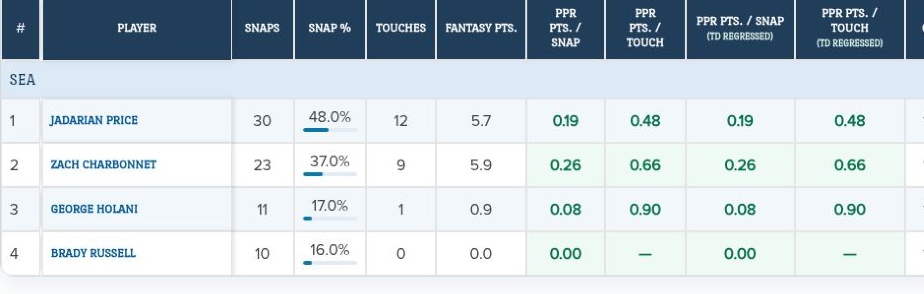
What our tools say: Price led Week 8 snaps 30–23 (48%–37%) and touches 12–9. Charbonnet nevertheless produced 0.26 PPR points per snap and 0.66 per touch, compared with Price’s 0.19 and 0.48. Neither scored a touchdown, so the TD-regressed rates are identical. The smaller role was more productive per opportunity that week; it was not a takeover. Our RB16 Charbonnet versus RB27 Price order remains a projection for a shared backfield, which is why Charbonnet is an RB2 and Price a flex. Across the field, Allgeier’s 36.1 PPR points included two touchdowns: remove them and his rates fall from 0.75 / 2.26 to 0.50 / 1.51. There was substantial production beyond the scores, but Knight’s absence still needs an updated workload estimate. JSN draws the #29 WR1 matchup; Wilson’s is a harder #6.
Before lock: Darnold is out. Drew Lock (QB18) is a superflex/QB2 option, not a 10–12-team one-QB start at QB18. Lock has been limited by an elbow injury, so confirm the starter before committing. Wilson’s rib issue adds to an already difficult matchup.
GAME 13 · Sunday, November 8 · 8:20 p.m. ET
Tampa Bay at Chicago
Chris Godwin remains a WR3 recommendation. Rome Odunze is the interesting role-matchup pivot, while Colston Loveland is one of the strongest TE starts on our board.
Start: Caleb Williams (QB9), Bucky Irving (RB9), D'Andre Swift (RB13) and Colston Loveland (TE3), subject to the final active list. Luther Burden III (WR25) and Chris Godwin Jr. (WR26) are 12-team WR3/FLEX plays rather than shallow-league locks.
Flex and deeper leagues: Rome Odunze (WR38) is a 14–16-team flex or a 12-team option when you need upside and start three receivers. Tez Johnson (WR37) is another deeper flex. In a 10-team, two-WR lineup, we would usually choose a stronger projected receiver than either.
Sit / prefer another option: Baker Mayfield (QB21) in one-QB leagues and Cade Otton (TE25) in ordinary one-TE leagues. Do not start a lesser Tampa receiver solely because Emeka Egbuka is questionable; use the revised projections if he is inactive.
What our tools say: The screenshot shows why Odunze has appeal as an upside flex: Tampa Bay allows the listed WR2 role 14.5 PPR points per game, 3.1 above expectation, with a #31 matchup grade. Its WR1 role allows 6.1, 7.0 below expectation, for the hardest #1 grade. These are defensive role averages, not player forecasts. Our rankings still favor Burden, WR25 to WR38, and last week’s volume helps explain it: Burden drew nine targets and caught seven passes on 40 snaps; Odunze drew six and caught four on 63 snaps. Remove Burden’s touchdown and he still posted 0.32 points per snap versus Odunze’s 0.20. Odunze’s touchdown-free 3.18 points per catch looks good, but that measure excludes incomplete targets and cannot replace target volume. Use WR Matchups for the upside case and the rankings/Snap Counts for the full decision. Swift handled 29 touches.

Before lock: Egbuka is questionable. Kyle Monangai is also questionable, which matters to Swift’s projected share. Irving and Godwin have practice flags on the ranking snapshot. Keep a Sunday-night or Monday-night fallback if your starter’s availability is unsettled.
GAME 14 · Monday, November 9 · 8:15 p.m. ET
Buffalo at Minnesota — Monday Night Football
The hardest aggregate matchup does not send Josh Allen to the bench. The more difficult decisions are Buffalo’s receivers and the middle of Minnesota’s lineup.
Start: Josh Allen (QB5), James Cook III (RB7) and Justin Jefferson (WR13). Allen and Cook remain top-seven at their positions despite Minnesota’s difficult defensive profile.
Flex and deeper leagues: DJ Moore (WR32) is a 12-team WR3/FLEX if active. Aaron Jones Sr. (RB29) is a 12-team flex rather than a clear RB2. Jordan Addison (WR40) and Khalil Shakir (WR47) are more appropriate 14–16-team flex choices. Dalton Kincaid (TE13) is just outside the 12-team TE1 line, but a viable deeper-league starter if healthy.
Sit / prefer another option: Carson Wentz (QB28) in one-QB formats, T.J. Hockenson (TE20) in ordinary one-TE leagues and Keon Coleman (WR61) in normal 10–12-team lineups. Hockenson remains usable in two-TE formats; we prefer Dulcich or Johnson when both are available.
What our tools say: The WR Matchups board gives Jefferson the easiest WR1 assignment (#32), but Addison’s WR2 assignment is #9. Buffalo’s aggregate receiver matchup is difficult; Moore’s individual role grade is nearer the middle (#18), while Shakir’s is #10. This is exactly where role-level research adds detail to a broad Points Allowed ranking.
Before lock: Moore, Kincaid and Coleman carry injury flags on the snapshot. Waiting for Monday news is only sensible with a Monday replacement available. Put a Monday WR in FLEX where possible; that can preserve an RB or TE alternative in leagues that allow it.
Proptimizer: separate a good line from a lineup start
The rendered active-game board supplied these Week 9 receiving-yardage comparisons. Bijan, Pitts, Dulcich and Johnson connect directly to our lineup recommendations. Bell illustrates the distinction: a low yardage line can be attractive while the player remains only a deep-league flex.
| Player | Market | Board call | Projection | Listed price |
|---|---|---|---|---|
| Bijan Robinson | Receiving yards | OVER 24.5 | 54 | −112 |
| Kyle Pitts Sr. | Receiving yards | OVER 41.5 | 69 | −112 |
| Greg Dulcich | Receiving yards | OVER 39.5 | 64 | −110 |
| Juwan Johnson | Receiving yards | OVER 29.5 | 53 | −115 |
| Kenneth Walker III | Receiving yards | OVER 17.5 | 31 | −115 |
| Chris Bell | Receiving yards | OVER 23.5 | 52 | −113 |
Market snapshot shown by Proptimizer: November 4, 2026 at 10:04:55 a.m. ET, labeled “BettingPros live offers cross-checked by ScoresAndOdds.” Read from the populated board on November 6, with completed TNF excluded. Individual cards did not identify a sportsbook. Recheck both the line and player status before using a price. These are receiving-yardage projections, not PPR fantasy-point forecasts or win probabilities.
Make your final comparison with the right tool
Rankings set our overall order. WR Matchups adds role-specific context. Points Allowed shows broader defensive results. Snap Counts separates playing time from touches and targets; choose the last completed game rather than treating a bye as zero production.
Use Start / Sit for your actual alternatives and scoring. Use Ask Max for the appropriate DraftKings slate, and Proptimizer for posted lines. A receiver can be a good yardage-over candidate and still belong on a shallow season-long bench.
The final job: check Madrid inactives first, then the 1 p.m. games, then the late slate. Save your FLEX flexibility for the players whose news comes last.
Sources and update notes
Prepared November 6, 2026. Rankings display a November 6 update. WR-role report snapshot: November 5 at 22:23 UTC. Usage figures use completed Week 8; the report’s current-week header can show Thursday’s Week 9 import separately. Start/sit and league-size labels are editorial interpretations of our verified board, not claims that each pairing was separately run through the comparison tool.
- FullTime Week 9 QB rankings
- FullTime Week 9 RB rankings
- FullTime Week 9 WR rankings
- FullTime Week 9 TE rankings
- Role-specific WR Matchups
- Snap Counts — Week 8 selected
- Points Allowed
- Proptimizer — active Week 9 games
- NFL Week 9 schedule
- NFL Friday news: Wilson, Hall, Henderson, Ferguson, Pickens and Egbuka
- Browns confirm Sanders will start
- Eagles confirm Milton will start
- Seahawks: Darnold out, Lock expected to start
- Skattebo Friday practice update
- Thursday guide — source article